







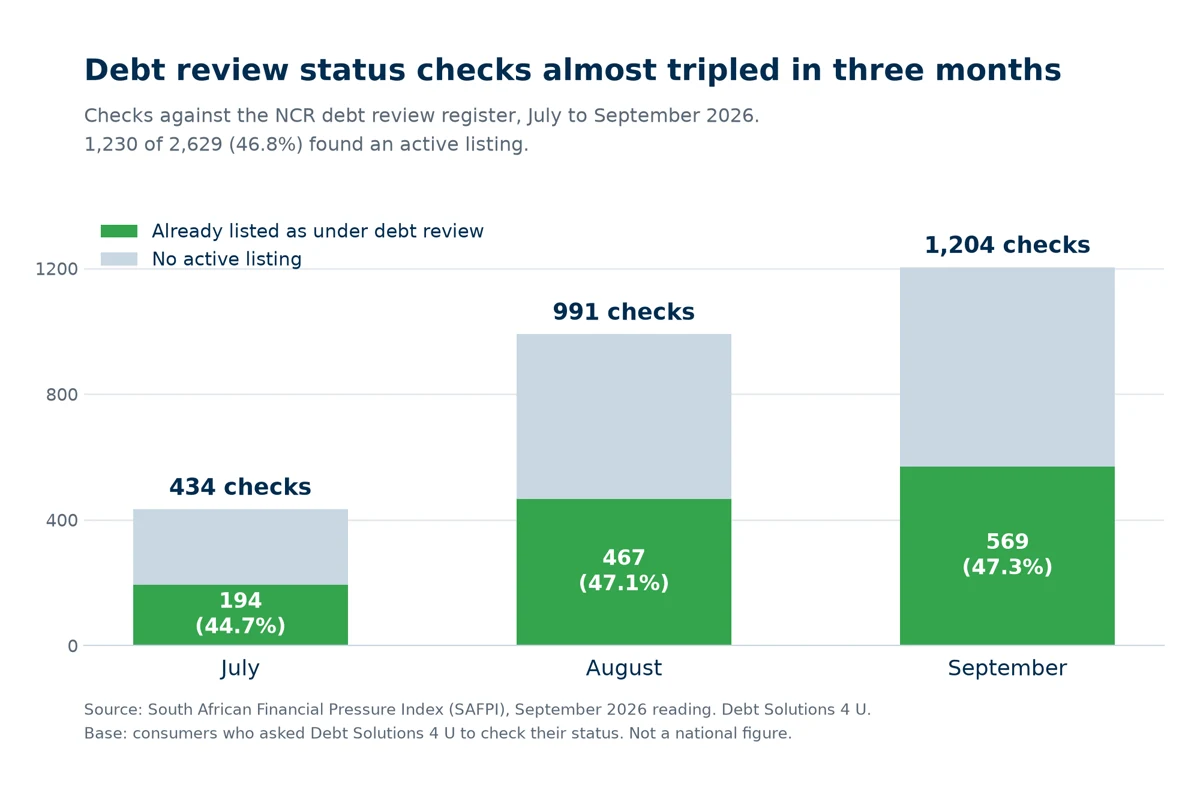
The number of South Africans asking whether they are already under debt review almost tripled between July and September 2026, and close to half of them were. That is one of the findings in the September reading of the South African Financial Pressure Index (SAFPI), published by NCR-registered debt counselling practice Debt Solutions 4 U.
The practice checked 434 consumers against the National Credit Regulator's debt review register in July, 991 in August and 1,204 in September. Of the 2,629 checks in the quarter, 1,230 (46.8%) found an active listing. The share barely moved from month to month: 44.7% in July, 47.1% in August and 47.3% in September.
Before each check, consumers are asked what they believe their status to be. Of the 1,857 who answered, 960 (51.7%) said they were not sure. Among the 897 who gave a definite answer, 219 (24.4%) were wrong.
“People assume they would know if they were under debt review,” says Rowan Breeds, lead debt counsellor at Debt Solutions 4 U. “One in four of the people who told us they were certain had it wrong. Many settled their accounts years ago and never received a clearance certificate. Others had a counsellor withdraw and thought that was the end of it, or agreed to something on a phone call without understanding what it was.”
The data does not record how each person came to be listed, and Debt Solutions 4 U makes no claim that these consumers were listed improperly. But the question is in the news. On 15 September the National Consumer Tribunal fined a debt counsellor R1 million and ordered her deregistration after finding, among other things, that 216 consumers had been placed under debt review without their consent (Sowetan, 1 October 2026).
The index: R58 of every R100
SAFPI is the median share of net monthly income that debt review applicants are already paying towards unsecured debt when they apply. For the three months to 30 September 2026 it was 58.0%, measured across 1,139 applications. The August reading was 58.4%, across 1,174.
Breeds does not read the 0.4 point difference as relief. “On a sample this size that is no movement at all. Every reading we have published sits between 57.6% and 58.4%. The typical person who asks us for help is paying R58 of every R100 they take home to unsecured lenders. Rent, food, transport, a bond and a car all have to come out of what is left.”
More than half of applicants, 636 of the 1,139 (55.8%), commit over half of their net income to unsecured debt.
Measured before the rate increase
The sample closed on 30 September, five days after the South African Reserve Bank's latest increase took effect. The repo rate is now 7.25% and prime 10.75%, following the second increase of 2026. The Bank expects headline inflation to rise above 5% later this year and into early 2027 (SARB MPC statement, September 2026). The Monetary Policy Committee meets again on 19 November, eight days before Black Friday.
Nationally, households spend 9.4% of disposable income servicing debt, and household debt stands at 61.3% of disposable income (SARB Quarterly Bulletin, September 2026). SAFPI does not contradict those figures. The national ratio covers every household. SAFPI covers the ones that have run out of room.
Most applicants take home less than R10,000 a month
Of the 1,176 applications in the index's income table, 546 (46.4%) came from people taking home between R5,000 and R10,000 a month. Their median unsecured debt was R9,396. Their median monthly repayment on it was R4,018, which is between 40% and 80% of what a person in that bracket takes home. A further 227 applicants took home less than R5,000. Together the two groups are 773 of the 1,176, or 65.7%.
“R9,396 is not a large debt,” says Breeds. “It becomes unpayable because of what it costs each month. These are small balances carrying very large instalments.”
Personal loans are two thirds of what is owed
Personal loans made up 3,600 of the 5,543 unsecured accounts in the sample (64.9%) and R40.57 million of the R63.16 million owed (64.2%). Credit cards were 13.7% of the accounts and 21.5% of the balance. Store cards were 10.2% of the accounts but only 4.6% of the balance.
Lenders' own data points the same way. TransUnion's Industry Insights Report for the second quarter of 2026 recorded non-bank personal loan originations up 21.3% year on year, with the average new loan 5.9% smaller and 54.6% of non-bank personal loan balances delinquent (FAnews, 29 September 2026).
What consumers can do
Anyone who is unsure of their status can ask an NCR-registered debt counsellor to check the register. Debt Solutions 4 U runs the check free of charge at debtsolutions4u.co.za/debt-review-status-check, and it does not affect a credit score. A credit report on its own is not reliable confirmation. A consumer who has paid everything covered by a debt review still needs a clearance certificate before the listing is removed.
About the data
SAFPI describes people who applied for debt review through Debt Solutions 4 U. It is not a national average and should not be reported as one. It measures how deep the difficulty is among people who have asked for help, not how many South Africans are in difficulty.
Income is declared by the applicant. Repayments and balances come from account-level credit bureau records. Medians are used throughout. The index is a rolling three-month figure because single months move by several points on samples of this size. Secured accounts (home loans and vehicle finance) are excluded. Groups smaller than ten are not reported as percentages.
The full reading, the monthly series, the tables and the method are published at debtsolutions4u.co.za/article/safpi-south-african-financial-pressure-index-2026 under a CC BY 4.0 licence. The aggregate tables are available on request.
Ends
Media contact: Rowan Breeds, Lead Debt Counsellor (NCRDC2423), Debt Solutions 4 U. [email protected], +27 82 745 6778, www.debtsolutions4u.co.za
About Debt Solutions 4 U: Debt Solutions 4 U is an NCR-registered debt counselling practice (NCRDC2423) and a member of DCASA. It publishes the South African Financial Pressure Index (SAFPI) every month from anonymised debt review application data.
Fact sheet
| Measure | September 2026 reading | August 2026 reading |
|---|---|---|
| SAFPI (median share of net income to unsecured debt repayments) | 58.0% (n = 1,139) | 58.4% (n = 1,174) |
| Rolling window | July to September 2026 | June to August 2026 |
| Applicants above 50% | 55.8% (636) | 56.0% (657) |
| Personal loans, share of unsecured balance | 64.2% (R40.57m of R63.16m) | 65.4% (R51.66m of R79.02m) |
| Personal loans, share of unsecured accounts | 64.9% (3,600 of 5,543) | 63.0% (3,683 of 5,842) |
| Register checks in the latest month | 1,204 (September) | 991 (August) |
| Checks finding an active listing | 46.8% of 2,629 (July to September) | not published as a quarter figure |
| Unsure of own status | 51.7% (960 of 1,857) | 51.3% (403 of 786) |
| Definite answers that were wrong | 24.4% (219 of 897) | 24.5% (of 383) |
| R5,000 to R10,000 net income: median debt / repayment | R9,396 / R4,018 (n = 546) | R9,462 / R4,051 (n = 542) |
Register checks by month: July 434 (194 active, 44.7%), August 991 (467 active, 47.1%), September 1,204 (569 active, 47.3%).
Frequently Asked Questions
How many debt review status checks were done between July and September 2026?
Debt Solutions 4 U checked 434 consumers against the National Credit Regulator's debt review register in July, 991 in August and 1,204 in September. Of the 2,629 checks in the quarter, 1,230 (46.8%) found an active listing. The share barely moved from month to month: 44.7% in July, 47.1% in August and 47.3% in September.
How many people are wrong about their own debt review status?
Before each check, consumers are asked what they believe their status to be. Of the 1,857 who answered, 960 (51.7%) said they were not sure. Among the 897 who gave a definite answer, 219 (24.4%) were wrong.
What was the September 2026 SAFPI reading?
For the three months to 30 September 2026 SAFPI was 58.0%, measured across 1,139 applications. The August reading was 58.4%, across 1,174. SAFPI is the median share of net monthly income that debt review applicants are already paying towards unsecured debt when they apply. More than half of applicants, 636 of the 1,139 (55.8%), commit over half of their net income to unsecured debt.
Is SAFPI a national average?
No. SAFPI describes people who applied for debt review through Debt Solutions 4 U. It is not a national average and should not be reported as one. It measures how deep the difficulty is among people who have asked for help, not how many South Africans are in difficulty.
How can I check whether I am under debt review?
Anyone who is unsure of their status can ask an NCR-registered debt counsellor to check the register. Debt Solutions 4 U runs the check free of charge, and it does not affect a credit score. A credit report on its own is not reliable confirmation. A consumer who has paid everything covered by a debt review still needs a clearance certificate before the listing is removed.