

Most people who ask us to check their status expect to hear nothing much. Nearly half of them are wrong. Of the last 524 people who ran a check against the National Credit Regulator's register, 44.1% turned out to be actively listed under debt review, and most had no idea.
What You Get
The full check produces a personal credit and debt options report. It shows what you owe, what you are contractually expected to pay each month, what you actually have available after living expenses, and whether a debt review is running in your name. Here is a sample, using fictional figures.
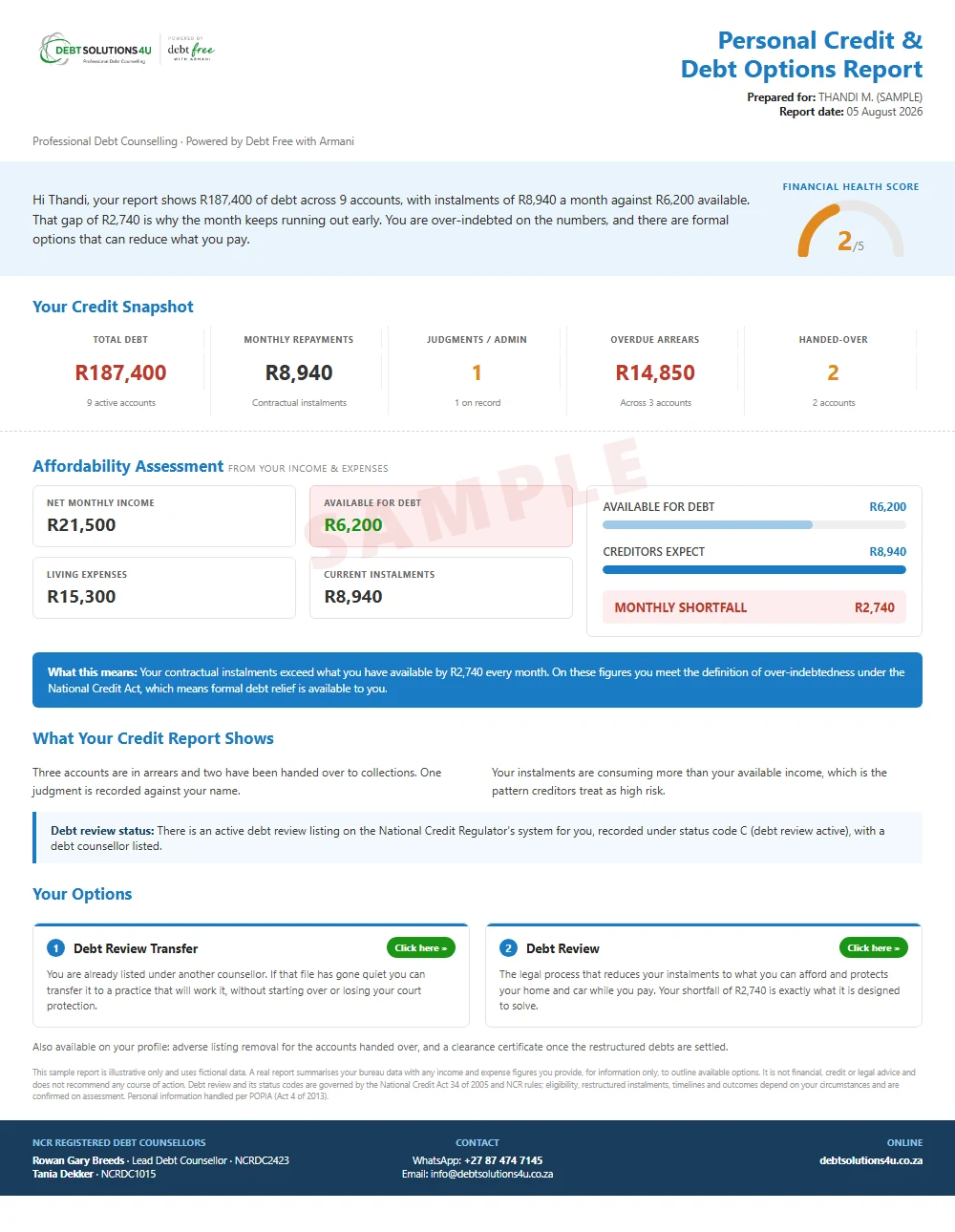
Sample report with fictional data, for illustration.
Two ways to run it
Full report. Your credit record, affordability assessment and NCR debt review status. You need your ID number, your monthly income and your monthly expenses. About two minutes.
Status check only. Just the NCR register answer: are you listed, under which status code, and with which counsellor. You need only your ID number. A few seconds.
Why Not Just Look at Your Credit Report?
You can, and you should claim your free bureau reports anyway. But a credit report is not a reliable source for this particular question. The debt review indicator on a bureau profile is set and cleared based on updates filed by debt counsellors and payment distribution agencies, so it depends on other people reporting accurately and on time.
We know how badly that can drift because we tested it. Building our monthly financial pressure index, we compared the bureau debt review field against the NCR register for the same people. The bureau field said "under debt review" for everybody. The register put the real figure at 44.1%. The two disagreed on 152 of 336 matched cases. The register is the legal record, so that is what we check.
The full explanation is in our guide to what your credit report will not tell you, and if you would rather check on your own, all three free ways to check your status are set out there.
What the NCR Status Codes Mean
A register listing carries a status code, and the code decides what you should do next. Being on the register does not automatically mean a debt review is running. Several codes mean the opposite.
Two things are worth separating, because published guides routinely confuse them. A code can be currently in use on the NCR's Debt Help System, and separately it can mean your debt review is still active. Codes I and J are in current use but end the process rather than continue it. The definitions below follow NCR Circular 02 of 2022 and have been confirmed by our lead debt counsellor, Rowan Breeds (NCRDC2423).
| Code | What it means | Still under debt review? |
|---|---|---|
| A | You have applied for debt counselling and your application is being assessed. | Yes |
| B | The assessment resulted in a rejection, usually because you were not found to be over-indebted. | No |
| C | The assessment concluded that you are over-indebted. | Yes |
| D3 | Formal debt restructuring through the courts has commenced. | Yes |
| D4 | Formal restructuring is complete and a court order has been granted. | Yes |
| F1 | All restructured debts are settled except a mortgage that meets the section 71 requirements, including not being in arrears. | No — cleared |
| F2 | All restructured debts have been settled. | No — cleared |
| G | A magistrate rescinded the debt review court order, or you opposed the application and were declared not over-indebted. | No |
| G1 | A magistrate rejected the debt review application because you were not over-indebted. | No |
| I | The consumer is deceased. | No — terminal |
| J | The consumer has been sequestrated. | No — terminal |
Suspension (Form 17.W) is not a status code
A debt counsellor may suspend their services, recorded through a suspension indicator following Form 17.W(b). This does not end your debt review and it does not change your code. You stay on whichever status already applied, with the suspension noted on top of it. If your counsellor has gone quiet, the fix is a transfer to another practice, not a new application.
Legacy codes that may still appear on older records
Two codes are no longer used for new updates but can still sit on historical records. Several published guides still present them as current, which is where a lot of confusion starts.
| Code | Historical meaning | Current position |
|---|---|---|
| A1 | Voluntary withdrawal before being declared over-indebted. | Disabled. NCR Circular 02 of 2022 records this code as no longer applicable. |
| H | Historical debt counsellor withdrawal outcome. | Inactive historical code. A suspension of services no longer moves you to H — you stay on whichever status already applied. |
The one that catches people
A counsellor withdrawing or suspending services does not end your debt review. Once you have been accepted into the process, only a clearance certificate or a court order ends it. What has changed is the paperwork: a suspension no longer moves you to code H, so if you are checking an older record and see H, treat it as history rather than your current position and confirm what actually applies today.
What Happens After the Check
It depends entirely on what comes back, which is the point of checking rather than guessing.
If nothing is listed and your affordability looks fine, you have your answer and you owe us nothing. If your restructured debts are settled but a listing remains, you need a clearance certificate. If a review is active but your file has gone quiet, you can transfer to a counsellor who will work it. If you were never lawfully placed under review, the listing can be disputed, and our guide to removing debt review covers each route and what it costs. And if the numbers show you genuinely cannot afford your instalments, debt review is the process built for that.
Checking You Can Trust
Debt review attracts scams, so verify anyone who offers to check or clear your status. Every legitimate debt counsellor in South Africa holds an NCRDC number issued by the National Credit Regulator. Ours is NCRDC2423, held by Rowan Breeds, and you can confirm it yourself on the NCR register of registrants before you share anything. Nobody legitimate charges you to find out your status, and nobody legitimate promises to make a listing disappear. If you want the warning signs in full, read how to spot a debt review scam.
Your information is handled under POPIA and used to run your check and prepare your report. Aggregate, anonymised figures feed our monthly index. Your name and ID number never appear in anything we publish.
Related Guides
If you would rather read before you check, these cover the ground in detail.
- Three free ways to check your debt review status — including how to do it yourself through the bureaus or the NCR.
- What your credit report will not tell you — why the bureau flag and the register disagree.
- How to claim all four free bureau credit reports — your annual entitlement under the National Credit Act.
- Paid up but still listed under debt review — what to do when the debts are settled and the flag remains.
- The three legal routes out of debt review — clearance certificate, court rescission, or bureau dispute.
- How the clearance certificate works — the document that formally ends debt review.
- The South African Financial Pressure Index — the monthly research these checks feed into.
Where these definitions come from
Code meanings follow NCR Circular 02 of 2022, which sets out the DHS status codes and records A1 as no longer applicable. The NCR's March 2026 DHS go-live guideline expressly provides for updates to A, B, C, D3, D4, F1, F2, G, G1, I and J, together with 17.W suspension indicators, and makes no provision for updates to H. The suspension position follows the NCR's 2021 withdrawal guideline. All definitions on this page have been confirmed by Rowan Breeds, NCR-registered debt counsellor (NCRDC2423). If you believe anything here is out of date, tell us and we will correct it.
Reviewed by a registered debt counsellor, NCRDC2423. Statistics from the SAFPI baseline report, August 2026.
Frequently Asked Questions
Am I under debt review?
There is one authoritative way to find out: the National Credit Regulator's debt review register. Give your ID number to any NCR-registered debt counsellor and they can query it for you, which is what our free check does. You are more likely to be listed than you might expect. Of the last 524 people who ran a check with us, 44.1% were actively listed on the register, and most did not know before they checked. Common reasons include an application you started years ago and abandoned, a completed debt review where the clearance certificate was never issued, or a spouse's application in a marriage in community of property.
How do I know if I am under debt review?
Most people find out the hard way, when a credit application is declined and someone mentions a flag on their profile. You do not have to wait for that. Check the NCR register with your ID number, either through a registered debt counsellor or by phoning the NCR on 0860 627 627. Your credit report may also carry a debt review indicator, but that field is filed by third parties and drifts out of date, so treat it as a hint rather than an answer. The register is the legal record.
How do I check my debt review status for free?
Give an NCR-registered debt counsellor your ID number and they can query the National Credit Regulator's debt review register on your behalf. At Debt Solutions 4U (NCRDC2423) this is free and takes a few seconds on chat. You can also request your free annual credit report from TransUnion, Experian, Compuscan or XDS and look for a debt review indicator, or phone the NCR on 0860 627 627.
What do I need for the free check?
For a status check, only your South African ID number. For the full credit and debt options report you also need your net monthly income and a rough figure for your monthly living expenses. That is what lets us calculate whether your instalments actually fit your income. The whole thing takes about two minutes.
What does the report show me?
Your total debt and number of active accounts, your monthly instalments, any judgments, arrears or handed-over accounts, a financial health score, and an affordability assessment showing what you have available for debt versus what creditors expect. It also states plainly whether there is an active debt review listing on the NCR register in your name, and sets out which options apply to your situation.
Does a credit report show if I am under debt review?
Not reliably. Credit bureaus carry a debt review indicator, but it is set and cleared based on updates filed by debt counsellors and payment distribution agencies, so it drifts out of date. The NCR register is the legal record. When we tested the bureau field against the register on our own checks, the two disagreed on 152 of 336 matched cases, which is why we always report status from the register.
Will checking my status affect my credit score?
No. Checking your own record is a soft enquiry and does not affect your credit score. Only hard enquiries, which happen when you apply for credit and a provider checks your profile, can lower it. You can check your own status as often as you like without any consequence.
What do the NCR debt review status codes mean?
Following NCR Circular 02 of 2022: A means you have applied and are being assessed; B means the assessment was rejected, usually because you were not over-indebted; C means you were found over-indebted; D3 means court restructuring has commenced; D4 means a court order was granted. Those are the active codes. F1 and F2 are clearance outcomes, G and G1 are court outcomes finding you not over-indebted, and I and J record a deceased or sequestrated consumer. A1 and H are legacy codes that are no longer used for new updates.
Does code H mean I am still under debt review?
H is a legacy code and is no longer where a consumer ends up when a debt counsellor withdraws or suspends services. Under the NCR's withdrawal guideline, a suspension is recorded through a 17.W(b) indicator and you remain on whichever status code already applied, such as C or D4. If you see H on an older record, treat it as history and confirm your current status on the register. What has not changed is the underlying position: a counsellor stepping back does not end your debt review.
Am I signing up for debt review by running the check?
No. The check tells you where you stand and what your options are. Plenty of people run it, find nothing wrong, and carry on with their lives. If the check does show something, we will tell you honestly what applies, including when debt review is not the right answer for your situation.
